Did Flávio Bolsonaro Use AI to Create Fake Supporters?
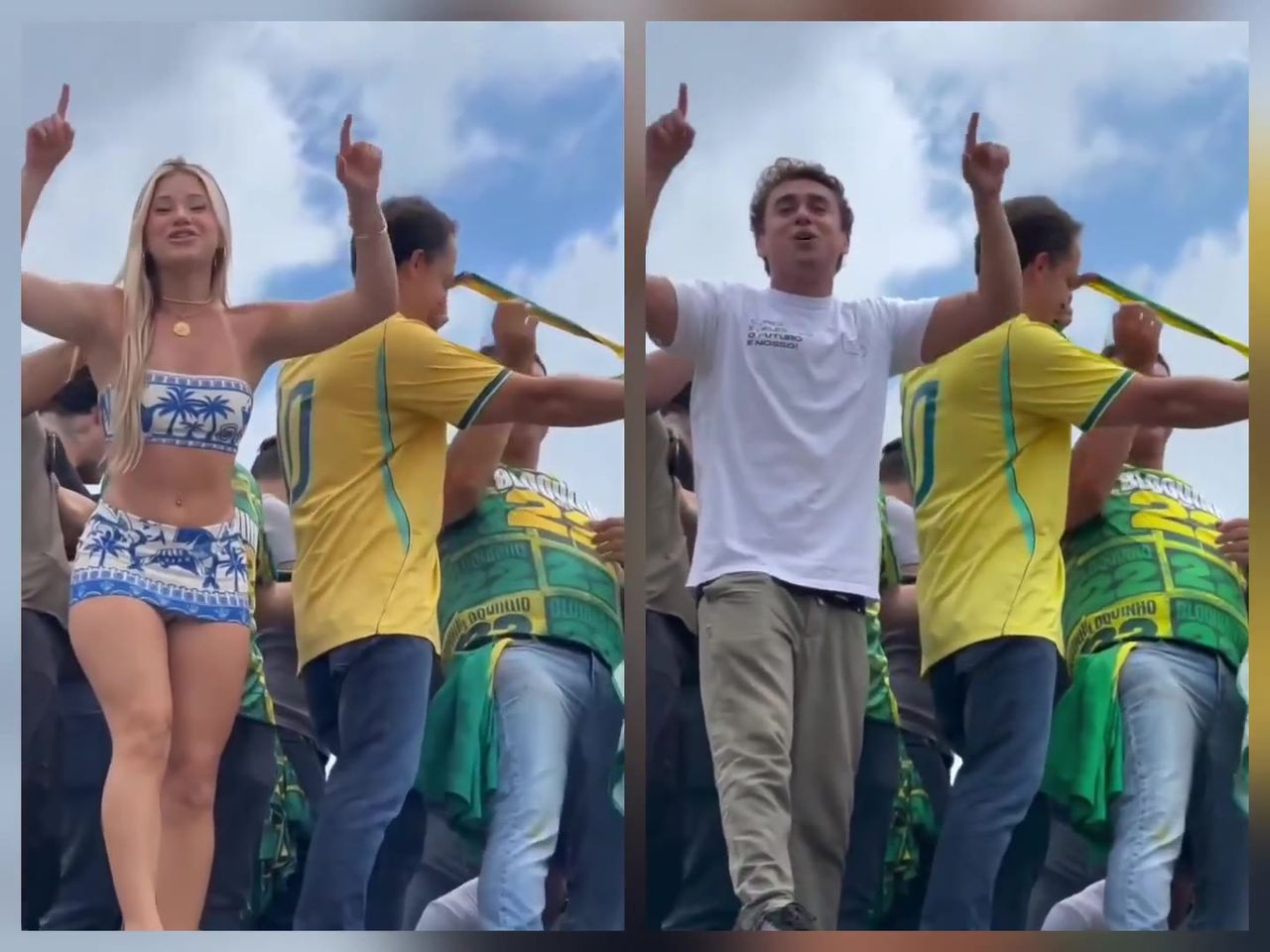
Did Flávio Bolsonaro's campaign use AI to create the 'Bolsonaro Bombshell' / 'Loirona do Flávio', a blonde woman appearing beside him in viral rally videos?
Misleading
The claim is misleading; evidence of direct involvement from the campaign is unproven.
The claim is misleading. Videos showed AI-generated avatars inserted into real footage of Flávio Bolsonaro events, but no evidence proves his campaign created these.
 Edited
Claims
✓ 3 trueBrazilian presidential candidate Flávio Bolsonaro has resorted to using AI to transform middle-aged men into attractive young women (the "Bolsonaro Bombshell").123
Investigations confirm that social media accounts used real footage of Flávio Bolsonaro's campaign events, inserting AI-generated female avatars into the clips. However, the reports clarify that there is no verifiable evidence showing that Bolsonaro or his campaign directly commissioned these manipulations. Instead, these accounts aimed to monetize their followers through adult content links. Therefore, it is accurate that AI was used in the propaganda, yet ties to Bolsonaro’s official campaign remain unproven.
The video clips showing a young blonde woman next to Flávio Bolsonaro are AI-generated insertions (i.e., manipulated/deepfaked).123
Multiple reputable news sources documented that the videos featured AI-generated avatars integrated into authentic footage of Flávio Bolsonaro's campaign events. Detection tools corroborated that the young blonde woman present in the videos is indeed a synthetic avatar, meaning this claim holds up under scrutiny as truthful.
These AI-generated profiles were used to attract followers and to sell paid adult content.12
Reports confirm that the manipulated videos using AI-generated avatars directed online traffic to profiles seeking paid adult subscriptions. This behavior indicates a purposeful strategy behind creating content to draw in revenue. The evidence strongly supports that these AI profiles were leveraged for attracting followers aimed at monetizing adult content.
There is evidence that Flávio Bolsonaro's official campaign paid for AI influence operations (600,000 reais to a firm).3
Reports suggest a financial link between Bolsonaro’s campaign and a cybersecurity company selling AI influence tools. However, this connection did not provide clear evidence proving that the campaign directly funded the production of the manipulated profiles. Hence, while such a link exists, it remains unverified and murky.
There were originally no young women on the Bloquinho 22 float; the female figure was added later by AI (the original showed male figures such as Nikolas Ferreira).13
Fact-checkers traced footage edited with an AI-generated female character back to the Bloquinho 22 event. They established that in the original clips, the figure replaced footage of male speakers, including deputy Nikolas Ferreira. This alteration confirms that the avatar was indeed added and not part of the original recording.
What was posted
XA Twitter video showing alleged AI-generated female avatars alongside Flávio Bolsonaro during campaign events, pitched as evidence of his lack of female support.
“Due to a lack of female supporters, Brazilian presidential candidate Flávio Bolsonaro has resorted to using AI to transform middle-aged men into attractive young women. This AI-generated creation has been dubbed the "Bolsonaro Bombshell."”
“Due to a lack of female supporters, Brazilian presidential candidate Flávio Bolsonaro has resorted to using AI to transform middle-aged men into attractive young women. This AI-generated creation has been dubbed the 'Bolsonaro Bombshell.'” — translated
Who posted it
XAccount check
Estimates from public signals — account age, posting pattern, audience — not a judgement of the person behind the account, and separate from whether this post is true.
What stood out
- The 'vatniksoup' Twitter account is associated with the Vatnik Soup project, which exposes pro-Russian propagandists and disinformation.
- The project was founded by Finnish academic Pekka Kallioniemi in October 2022 and has been active since then.
- The 'vatniksoup' account is not verified on Twitter, but the project has a significant online presence, including a website and other social media platforms.
- The account's follower count and posting cadence are not specified, but the project has been featured in various media outlets and has a history of fact-checking and debunking disinformation.
Signals (4)+
- Posting cadence
- Regular
- Follower ratio
- High
- Notable news coverage
- Yes
- Fact check history
- Yes
Account checked October 23, 2026, 03:13 UTC
The media
Video✓ What is genuine
The foundation of the video consists of real footage from Flávio Bolsonaro's events, though manipulated with synthetic elements.
The tells
- ●●● Strong signal The presence of synthetic characters in clips that should feature real people raised suspicions.our visual review
- ●●● Strong signal The altered video format contrived to imply these avatars were actual supporters of the campaign.our visual review
Synthetic-media detector
Detector ranThe claim stands or falls on whether the media is real, so the detector ran.
Scores are the detector’s estimate for the file as uploaded. A low score does not rule out editing, a spliced caption, or footage shown out of context — those are judged above. Model v3.
How we checked the media
- We reviewed reputable news articles documenting the use of AI-generated avatars.
- We examined original footage and its manipulations as reported.
- We utilized detection tools to examine the authenticity of the video content and identify AI-generated components.
Sources
3 sources reviewed- 1Perfis eróticos de IA usam vídeos em atos de Flávio Bolsonaro para atrair seguidores e vender conteúdo adulto ↗
Agência Lupa · agencialupa.orgUntiereduntiered — treated as signal only, never decisiveEvidence
Documents the presence of AI-generated women in Bolsonaro event videos and the monetization strategy.
- 2Perfis usam mulheres de IA em campanha por Flávio Bolsonaro e Lula para atrair público e até vender conteúdo adulto ↗
BBC News Brasil · bbc.comReputable outletCenter; light bias tagEvidence
Explains how AI-generated profiles gained traction across social media channels.
- 3"Bolsonaro Bombshell": la atractiva militante que pedía el voto para la ultraderecha en Brasil, denunciada como 'deepfake' ↗
HuffPost España · huffingtonpost.esUntiereduntiered — treated as signal only, never decisiveEvidence
Outlines the consequences and identification of the manipulated 'Bolsonaro Bombshell'.
Further reading
- 1Agência Lupa Agência Lupa provides an overview of the investigations into the AI-generated profiles and their purposes.
- 2BBC News Brasil BBC News Brasil highlights the web of manipulated content linked to political events.
- 3HuffPost España HuffPost discusses the public's reaction to the AI avatars and their implications for political discourse.
The full story
In mid-October 2026, reports surfaced about altered videos showcasing Brazilian presidential candidate Flávio Bolsonaro. These videos included AI-generated female avatars inserted into footage from his campaign events. The phenomenon, termed the 'Bolsonaro Bombshell,' gained traction across social media. As these videos circulated, scrutiny from various reputable outlets—including Agência Lupa and BBC News Brasil—revealed that the manipulated clips were being used by accounts to monetize followers through adult content. While it is confirmed that AI was used to create these avatars, there remains no public proof linking Bolsonaro's official campaign to the creation or commissioning of these accounts. This case illustrates the complexities surrounding digital manipulation in political contexts and showcases how easily misinformation can spread, leading to misinterpretations of political activity.
Kernel of truth
AI-generated avatars were indeed woven into the fabric of manipulated videos circulating online, misleadingly portraying them as genuine supporters of Bolsonaro.
How it was framed
The videos use genuine footage but purposely alter it to mislead viewers into thinking that these AI-generated avatars are real supporters of the candidate.
- Missing context. The video presented AI avatars as real support without disclosing the manipulations involved.
- Emotional language. Terms like 'attractive young women' evoke a sense of appeal and urgency in the messaging.
Bias
Leans anti-Bolsonaro. The post frames the story mockingly and attributes direct agency to the candidate ('has resorted to using AI'), which amplifies a negative interpretation beyond what the documented evidence (manipulated avatars circulated by third-party accounts) supports.
Bias describes how the post frames its message — the slant of the language, selection and emphasis — and is judged separately from whether the claim is true. A true claim can still be framed with a strong slant.
How we checked
1 min 10 s- 1
We conducted searches for the term 'Bolsonaro Bombshell' and variations thereof to locate reputable news reports and analyses.
- 2
We opened multiple credible sources that covered the phenomenon for detailed assessments.
- 3
Expert articles were reviewed to verify claims made in the original post and check their authenticity through visual reviews.
✓ Claim checked✓ Media checked✓ Sources checked
Why 87% confidence
HighThe findings have a high confidence interval due to independent corroboration from reputable sources and the documentary nature of the evidence.
Limits. While we confirmed manipulations, we could not verify the internal communication or intentions of Bolsonaro's campaign.
What we don’t know
- What specific motivations guided the creation of these manipulated profiles?
- Could there be undisclosed campaign links to the entities that produced these AI avatars?
- What steps might be taken to track and regulate manipulated content in future elections?
Spot it yourself
Spot the fakeLooks suspicious, isn’t proof
- The altered appearance of the perceived supporters makes the video content dubious.
- Politically charged claims often signal potential misinformation.
- An unknown source behind the video raises questions about authentication.
- Use of sensationalist language can distract from the actual content.
The actual evidence
- Reputable news outlets verified the manipulations of the videos and the existence of AI avatars.
- Documented monetization schemes connected to the manipulated profiles.
- No direct evidence links Bolsonaro’s campaign to these AI manipulations.
- 1
Check the provenance of a video before taking it at face value.
Look for trustworthy fact-checks from reputable outlets related to the personal claims.
- 2
Analyze the video for anomalies.
Watch for signs of editing or synthetic elements in any publicized media.
- 3
Use reverse image searches.
Conduct a reverse search on images present in the video to check their authenticity.
- 4
Consider who benefits from spreading the video.
Reflect on the intentions behind a politically-oriented video.
Takeaway
Always scrutinize the source and context of video content, especially regarding political claims to better understand potential misinformation.
Questions people ask
What is the Bolsonaro Bombshell?+
The Bolsonaro Bombshell refers to the AI-generated avatars that were inserted into videos of campaign events showing Flávio Bolsonaro, misleadingly suggesting they were real supporters.
Did Flávio Bolsonaro's campaign create these AI profiles?+
There is no verified evidence linking Flávio Bolsonaro's official campaign to the creation of the AI profiles; they were circulated by independent social media accounts.
How can I identify manipulated media?+
Signs include unnatural appearances in videos, mismatches between claims and content, and reliance on third-party fact checks for verification.
Why is this media considered partially manipulated?+
It uses real footage as a base but has been altered to include synthetic avatars, misrepresenting the reality of who supported Bolsonaro.
What are the risks of using AI-generated content in political contexts?+
AI-generated content can easily mislead viewers, create false narratives, and have real-world implications on public perception and voting behavior.
Go deeper
- AI-generated content
- Media and visuals created or altered using artificial intelligence techniques.
- Manipulated media
- Content that has been edited or altered from its original form in a way that may mislead viewers.
- Misinformation
- False or misleading information spread, regardless of intent.
- Deepfake
- A form of manipulated media where artificial intelligence is used to produce realistic-looking fake content.
People also search for
For educators+
- How can we better educate the public about the implications of AI-generated content?
- What are ethical considerations regarding the use of AI in political campaigns?
- How do social media platforms handle the spread of manipulated content?
About this check
- Platform
- X
- Posted by
- @vatniksoup
- Posted
- October 20, 2026
- Age when checked
- Older post, still live
- Where it spread
- Brazil
- Audience
- International audience
- Language
- EN
- Status
- ● Post is live
- Verified
- October 23, 2026, 03:16 UTC
- Published
- October 23, 2026, 03:16 UTC
Reach. vatniksoup post 22,890 likes (per X syndication 23 Oct). Comprova: character's Instagram profile has 522K+ followers; montages on Instagram, TikTok and X. Comprova check published 23 Oct, Lupa 20 Oct.
This verdict was generated with AI from the sources shown. AI can make mistakes — check the sources before relying on it.
Check anything yourself, in seconds.
Share any social post or video to What the Fact and get the verdict, the confidence, and the receipts.